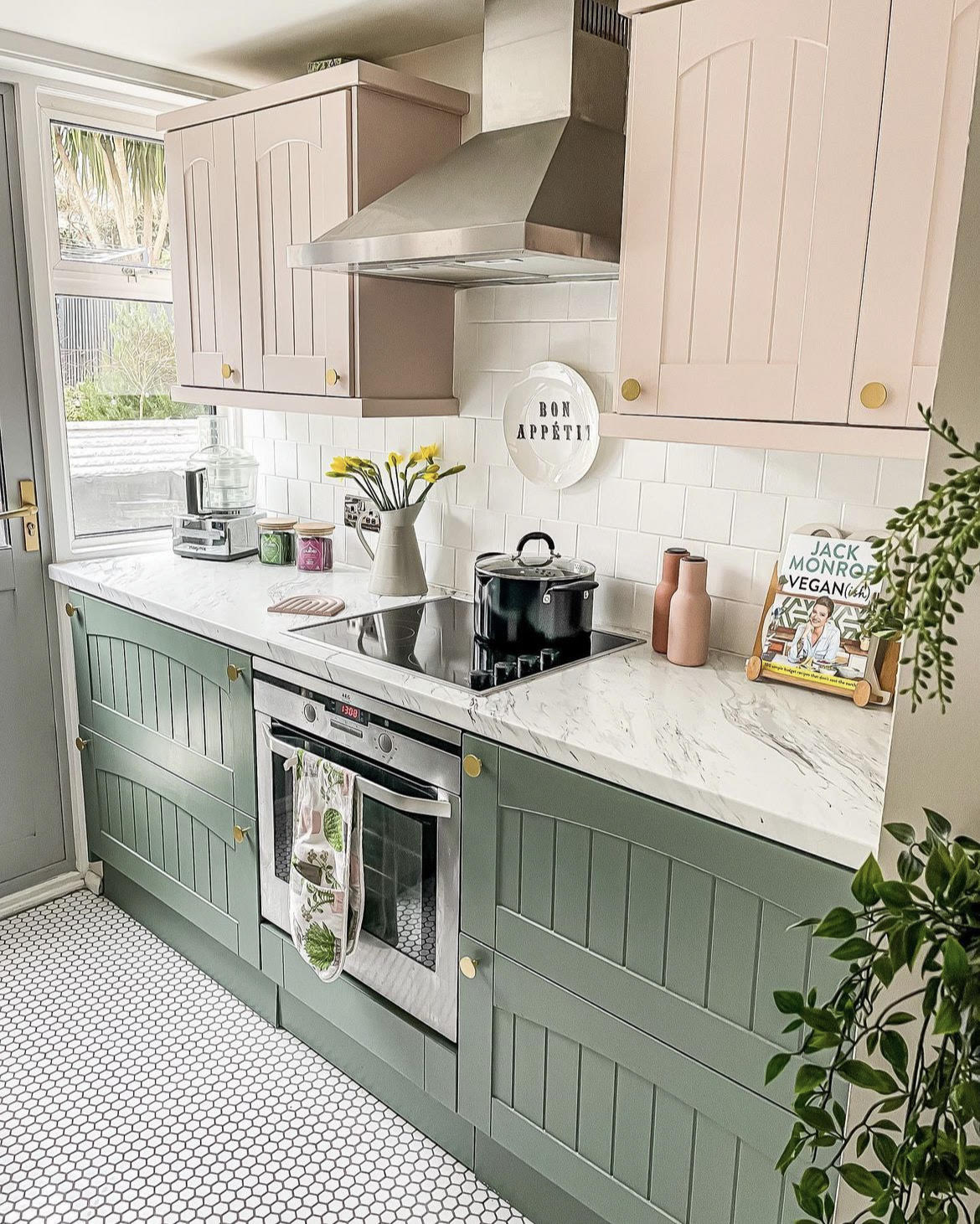
A kitchen is the hardest room in the house to change your mind about. A bedroom can be repainted in a weekend, but a kitchen colour lives on twenty doors, a worktop and a splashback, and most people keep it for a decade. The decision deserves more than a quick look at a colour card in a showroom.
Key takeaways
- A north-facing kitchen gets cool bluish light that turns grey cold and flat, so warm off-whites, clay tones and olive greens hold up better there.
- Test a kitchen colour on a full door or a board that size, left in the room for several days and checked at morning, midday, four o’clock and after dark.
- Cabinet doors, worktop, floor and splashback are the long commitment in a kitchen, so keep them in safe colours and let walls and bar stools carry the fashion.
- Muted greens, warm off-whites, soft greys and deep blues sit close to the natural world, so they do not belong to one season of fashion.
Decide what the room is for before you decide on a colour
Most kitchens now do several jobs at once. The same room is where breakfast happens, where homework gets done and where friends end up with a glass of wine at nine in the evening. Breakfast, homework and a late glass of wine each happen in a different light, and a kitchen colour has to survive all of them.
A shade that looks soft and welcoming at midday can turn heavy once the pendants come on after dark. A kitchen that doubles as the family living space needs to feel pleasant under artificial light for hours at a stretch, because the evening is when you will be sitting in it.
Which way the room faces decides more than taste
The direction a kitchen faces shapes how any colour behaves, and it is the factor most people overlook. A north-facing kitchen receives cool, slightly blue light that pulls the warmth out of a colour, so a grey that looked gentle on the card can turn cold and flat on the wall. Shades with some yellow or red underneath them hold up far better in a north-facing room, including warm off-whites, clay tones and greens that lean towards olive rather than mint.
A south-facing kitchen gets warm, strong light, so a bright yellow can become tiring by mid-afternoon. Cooler and more muted shades that would look lifeless in a north-facing room come into their own in a south-facing one.
Test kitchen colour ideas on the wall rather than in the showroom
A paint chip in a showroom tells you almost nothing, because the lighting is wrong, the scale is wrong and the colour is sitting beside shades that will never be in your house. Proper testing means a large sample, ideally a full door or a painted board the size of one, placed in the actual room against the actual wall.
Leave the sample in place for several days. Look at it in the morning, at midday, at four o’clock and under your own lights at night. Put the sample next to the things that are staying, such as the floor and the worktop, because a colour that is lovely on its own and wrong beside your floor is still wrong.
The five-year question
The useful way to think about longevity is to separate the parts of a kitchen that are expensive to change from the parts that are not. Cabinet doors, the worktop, the floor and the splashback are a long commitment, and replacing any of them means a tradesperson, a budget and a week of takeaways. Walls, blinds, bar stools and the things on open shelves can be changed on a Saturday for little money.
That split between permanent and temporary tells you where the risk belongs. Keep the long-term surfaces in colours you are confident about, and let the cheap layer carry whatever you are feeling this year.
Where to put a brave colour
A strong colour works best when it has somewhere specific to live. The island is the obvious candidate, since it reads as a piece of furniture rather than a wall of units. The inside of a larder cupboard is another good spot, because a deep colour behind a closed door is a pleasure every time you open it. A single run of base units in a darker shade, with the wall cupboards kept pale, gives the room a confident look while leaving an easy way out.
Whichever spot you choose for the strong colour, keep everything around it quiet. One bold decision looks deliberate, and three bold decisions in the same room start to argue with each other.
Shaker kitchen colours that keep working
A shaker door has a flat centre panel inside a raised frame, and the frame catches light differently from the panel, so a single colour reads as two closely related tones. Muted colours look richer on a shaker door than on a flat one, while very bright colours can look busier than intended.
The shades that keep working on a framed door are the ones with a little grey or earth in them. Muted greens, warm off-whites, soft greys and deep blues all suit the style and have done for a long time. Browse enough shaker kitchen ideas and the same handful of shades keeps appearing, and most of the shaker kitchen colours in well-made kitchens sit in that range. Greens, off-whites, greys and blues of that kind sit close to something in the natural world, so they do not belong to one season of fashion.
Sage green kitchen ideas that avoid the obvious
Sage is popular because it is soft enough to work as a neutral, it flatters wooden worktops and it takes both brass and chrome without complaint. The risk with sage is that it becomes the whole personality of the room. A sage green kitchen looks best when the colour is on the cabinets alone and the walls are kept to a warm white, or when sage is used on the base units with a paler stone colour above. If you want a green kitchen that feels less expected, look at the olive end of the spectrum rather than the minty end.
Handles, taps and the metal question
Metalwork is the easiest thing in a kitchen to replace, so choose it last and choose it to suit the colour. Brass warms a room and suits greens and blues well.
Two metals in one kitchen is fine, so brass handles with a chrome tap is a combination that works. Three metals in one kitchen is where the look starts to seem accidental. Decide on your two metals, use them consistently across handles, taps and light fittings, and the room will hold together however the walls change over the years.

